
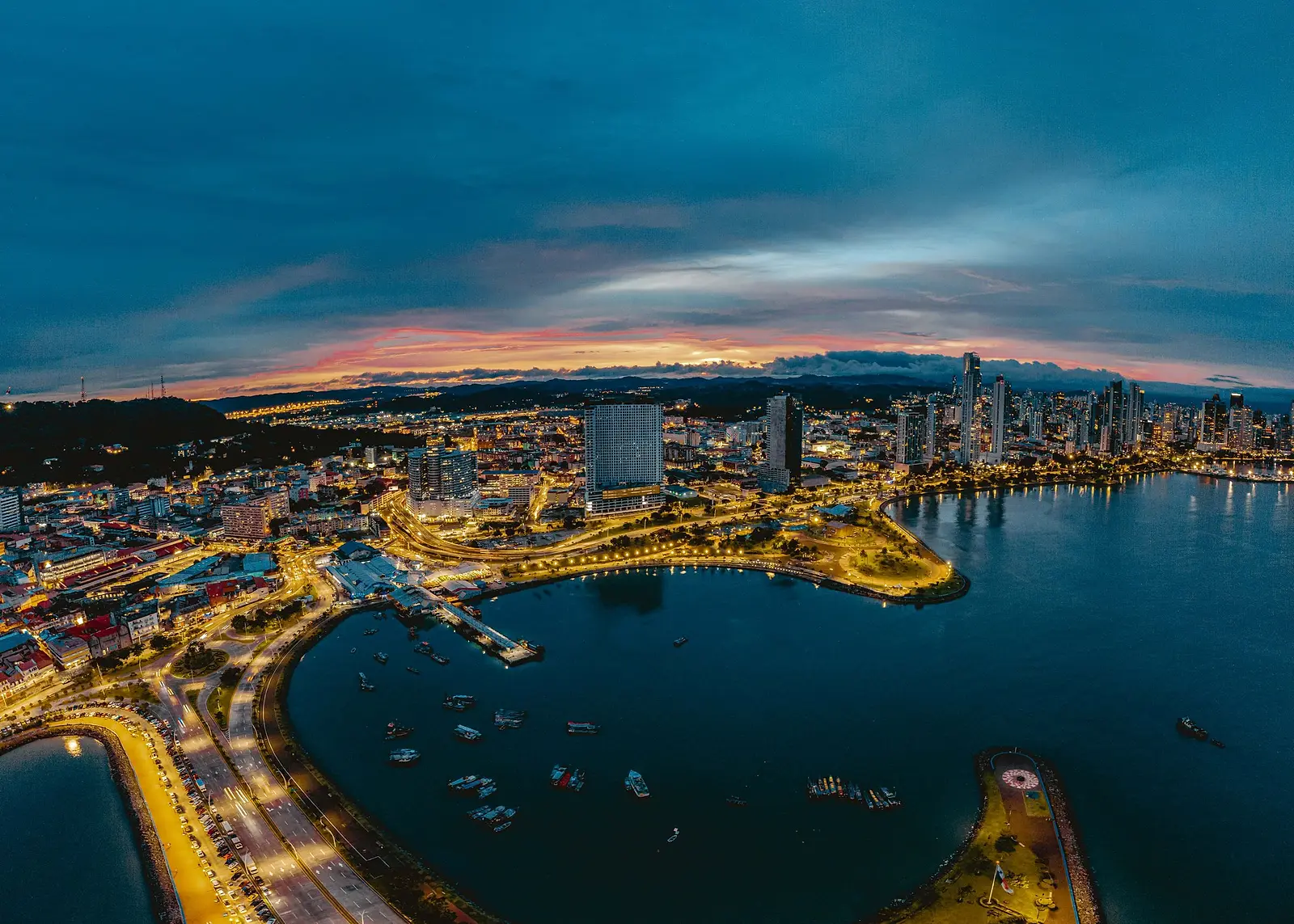
Panama, country view
Investment guide

Property investment in Panama

Panama remains one of the most open jurisdictions for foreigners in Latin America.

Photo: ZaetaFlow Sec, Pexels

$3,782/m²

Market median per sqm

Primary market of Panama City. The nine premium projects in our catalogue sit near the upper bound of the district range.

$217,000

Entry from

8

Projects in the catalogue

7.03%

Average gross yield

Strengths

  • The constitution puts a foreign buyer on equal footing with a citizen, a full freehold title (finca) is available through the Public Registry with no residency and no mandatory escrow required by law
  • The investment threshold for a residency visa is still one of the lowest in the region, 300,000 US dollars until October 15, 2026, then 500,000
  • Gross rental yield is high by global standards
2 more
  • The currency carries no peg risk: the balboa is pegged 1 to 1 to the US dollar, and the dollar is the currency actually in circulation
  • The market is recovering from a 2020 to 2024 downturn with moderate price growth

What to keep in mind

  • Net yield sits noticeably lower once taxes and management costs are counted
  • While in the luxury high-rise segment and part of the off-plan pipeline supply still runs ahead of demand, so a resale needs time in reserve
  • A mortgage is available to non-residents but pricier, and from 2026 new-build first sales run without the former transfer tax exemption, which is counted into the closing cost

The property market in Panama right now

$3,782/m²

Market median per sqm

Primary market of Panama City. The nine premium projects in our catalogue sit near the upper bound of the district range.

8

Projects in the catalogue

Units on sale: 37

2026-08-30

Exchange rate as of

openexchangerates.org, cross-checked

Spread of price per sqm in the catalogue

$3,169/m²$3,990/m²$4,975/m²

based on 8 of 8 projects

A price trend chart will appear once enough observations accumulate: daily snapshots of the catalogue aggregates have been collecting since August 2026, and we will not draw a line through a single point.

Buying rules in Panama

What a foreign buyer owns in Panama

Can a foreigner own property here?

a full title (finca) in the Public Registry, with no time limit and no special permits

Source: ExpatDen / International RE
More detail

The Panamanian constitution puts a foreign buyer on almost equal footing with a citizen for buying residential and commercial property: no residency, no special permit, and no escrow required by law. A full title is registered in the Public Registry in the buyer's own name, the property can be mortgaged and freely resold. The exception is the border strip and a share of plots sold under a weaker possessory right, and the difference has to be checked before any deposit is paid.

Ownership form for a foreign buyer
a full title (finca) in the Public Registry, with no time limit and no special permitsNeither residency nor a legally mandatory escrow account is required: the buyer registers the right in their own name, can mortgage the property with a bank, and can transfer it freely afterwards.Source: ExpatDen / International RE
Border restriction and weaker title
land purchase is banned within 10 km of the land borders with Costa Rica and Colombia; a share of plots are sold under a weaker possessory right (derecho posesorio)A derecho posesorio right is harder to finance with a bank and legally weaker than a full title. A lawyer checks the finca number in the Public Registry before any deposit precisely to tell the two apart.Source: International RE / TheLatinvestor
Taxes and fees

What taxes apply on purchase?

2%

Real estate transfer tax (ITBI)

2 percent of the higher of the cadastral value or the deal price

Source: PwC Tax Summaries / Kraemer & Kraemer
More detail

The one-off fee at purchase is small but got costlier for new builds from 2026; the tax at sale is flat, and personal income tax runs on a territorial principle with no detailed rental rate published in open sources.

Real estate transfer tax (ITBI)
2 percent of the higher of the cadastral value or the deal priceLaw 468 of April 2025 removed the historical ITBI exemption for the first sale of new builds after December 31, 2025 - from 2026 this raises the closing cost of new housing.Source: PwC Tax Summaries / Kraemer & Kraemer
Capital gains tax at sale
a flat 10 percent of net profitAt closing the seller pays an advance withholding tax of 3 percent of the deal amount or the cadastral value, whichever is higher; it can be treated as final or offset by filing a return computing the actual 10 percent and reclaiming the overpayment.Source: PwC Tax Summaries
Tax on rental income for a non-resident
a territorial principle - only Panama-sourced income is taxedThe exact rate on long-term rental income for a non-resident is not detailed in reliable sources. This does not cancel the duty to declare the income in the investor's own country of tax residence.Source: PwC Tax Summaries
Residency through a purchase

Does a purchase grant residency?

300,000 USD

Qualified Investor Visa

a real-estate investment from 300,000 USD until October 15, 2026, then a 500,000 USD threshold

Source: Global Citizen Solutions
More detail

Panama offers two investment routes to residency: a universal qualified investor visa and a cheaper visa for citizens of a list of friendly nations. Neither grants citizenship automatically.

Qualified Investor Visa
a real-estate investment from 300,000 USD until October 15, 2026, then a 500,000 USD thresholdGrants a direct path to permanent residency and is open to citizens of any country.Source: Global Citizen Solutions
Friendly Nations Visa
from 200,000 USD for citizens of a friendly-nations list (the US, Canada, Australia, France and others)Grants temporary residency for 2 years first; permanent residency is filed separately after that period.Source: Global Citizen Solutions
How the deal runs

How does the deal run?

10%

Deposit under the promesa

5 to 10 percent of the price, typically 10 percent

Source: Panama Sovereign / Panama-Properties
More detail

A deal in Panama is built around the promesa de compraventa and checking the finca in the Public Registry, not around an escrow law like in the UAE. The buyer's main protection is the lawyer's own due diligence, not a systemic bank requirement.

Deposit under the promesa
5 to 10 percent of the price, typically 10 percentHeld in escrow or with the seller's lawyer for the due diligence period.Source: Panama Sovereign / Panama-Properties
Lawyer's due diligence
the finca number in the registry, the seller's identity match, no property tax or HOA debtThis is a manual check, not a systemic escrow mechanism - its quality depends on the lawyer, not on the law.Source: Panama Sovereign / Panama-Properties
  1. Step 1. Check the property's finca number in the Public Registry before any payment is made.
  2. Step 2. Match the seller's identity in the deal against the registry record.
  3. Step 3. Check for outstanding property tax debt and unpaid condominium association dues.
  4. Step 4. Sign the promesa de compraventa and pay a deposit, typically 10 percent of the price.
  5. Step 5. Keep the deposit in escrow or the seller's lawyer trust account, never transfer it directly.
  6. Step 6. On off-plan, separately check the developer's track record and the confirmed construction progress.
  7. Step 7. Execute the final transfer deed (escritura) and register the title in the buyer's own name.

Cost of money and of holding

A mortgage is available to a non-resident in Panama, but it is dearer than a resident one and needs a larger down payment. There is no currency risk in dollars: the balboa is pegged to the dollar 1 to 1, and the dollar is the currency actually in circulation.

Non-resident mortgage
6.5 to 9.5 percent a year, down payment of 30 to 40 percent

The reference rate of Panama's Superintendency of Banks stood at 6.5 percent a year as of March 2026.

Source: TheLatinvestor / Superintendencia de Bancos de Panama
Foreign-borrower premium
1 to 2 percentage points higher than a resident rate, plus about 1 percent a year on investment property

Banks treat income earned abroad as riskier - hence both the rate premium and the extra fee on non-primary property.

Source: TheLatinvestor / Superintendencia de Bancos de Panama
Currency risk
the balboa is pegged 1 to 1 to the US dollar, and the dollar is the currency actually in circulation

Balboa banknotes are not in wide circulation on their own, so an investor's currency risk in dollars reduces to zero.

Source: IMF Article IV

Rental yield: what a source confirms

Below are published gross yield ranges with publisher and year. They are a market benchmark, not a computation for a specific unit: the platform has no rental model of its own for Panama, so none of these numbers is fed into a calculator or extrapolated over time.

Average gross yield
7.03 percent in the fourth quarter of 2025, 6.94 percent in the second quarter of 2026

Studios and one-bedroom flats in Panama City average 8.65 percent; the spread by district runs from 6.8 (Costa del Este) to 12.41 percent (Bella Vista).

Source: Global Property Guide
From gross to net
realistic net yield after costs and taxes is 4 to 5 percent a year

Noticeably below the stated gross yield once taxes, management and vacancy come out. Comparing the gross yield of one market with the net yield of another is not a comparison.

Source: Panama Elite Homes

What can go wrong

The risks of the Panama market are known and measurable. Below are the ones that change a decision rather than decorate it.

The main risk marker at any stage of the deal is a seller who cannot or will not provide the finca number for an independent check in the Public Registry before payment.

More detail

A separate category is dishonest off-plan developer schemes where buyer deposits vanish and projects go unfinished: Panama has no systemic escrow law that closes this risk for the buyer, so the full weight of the check rests on their own lawyer.

The second risk is oversupply and liquidity.

The luxury high-rise segment and part of the off-plan pipeline are overbuilt: secondary condo prices are flat or falling, while off-plan developers keep raising prices despite fewer closings.

More detail

The average sale-to-ask price ratio is 92 to 95 percent, and the resale discount in oversupplied districts reaches 10 to 12 percent. Property in Panama is less liquid than in the US or Canada: selling a unit typically takes months, not weeks.

Risk 1Main fraud markera seller who cannot or will not provide the finca number for a pre-payment check

Separately - off-plan: with no systemic escrow the deposit rests on the contract, so a developer's delivery record is checked before payment.

Source: TheLatinvestor
Risk 2Oversupply and liquiditysale-to-ask price ratio of 92 to 95 percent, resale discount of 10 to 12 percent in oversupplied districts

The luxury high-rise segment and part of the off-plan pipeline are overbuilt; selling a unit in Panama typically takes months.

Source: Panama Equity

Market direction

The price level of our catalogue sits higher up this page and is computed on our own sample. This block carries only external dynamics, macroeconomics and demand: the aggregate does not measure them and they do not argue with it.

Year on year price growth
2.38 percent in March 2025, cumulative growth from the September 2021 low of 7.38 percent

The market is in a gradual but segmented recovery phase after several years of discounts and oversupply.

Source: Global Property Guide / MLS Acobir
Economic backdrop
GDP growth of 4.4 to 4.5 percent in 2025, about 3.8 percent in 2026, inflation near zero

Recovery after the Cobre Panama mine closure and the Panama Canal returning to full capacity from September 2024; the 2026 inflation forecast is about 1.4 percent.

Source: IMF Article IV Consultation 2025
Tourist flow
3,004,266 tourists in 2025, up about 8 percent year on year

Tourism revenue reached 6.583 billion dollars against 4.6155 billion in 2018 - for short lets this is demand.

Source: Панамское управление туризма (ATP) через Newsroom Panama

We will shortlist projects in Panama for your budget and goals

Get a shortlist
Smart Matching

Properties selected to fit your budget and goals

Get a hand-picked list of investment properties, complete with yield figures, matched to your criteria

Your information stays protected and is never passed to third parties

Members-only catalog

Handpicked Investment Opportunities

A private, hand-selected list of uncommon deals built for serious investors: land, hotels, commercial property, development, co-investment, private lending and more

Takes half a minute. We don't do spam.

  • Rare deals that never hit the open market
  • Real analysis, not another listings feed
  • Straight-line access to deals worth a look
  • One-on-one advisory whenever you need it
  • Certain offers stay off the public catalog entirely
  • Every listing screened by our team first

Frequent questions about Panama

Can a foreigner actually buy property in Panama?

Yes. Panama's constitution puts a foreign buyer on equal footing with a citizen: a full title (finca) is available through the Public Registry, with no residency or special permits required, and the property can be mortgaged with a bank or resold freely. The one real restriction is land within 10 km of the borders with Costa Rica and Colombia, which cannot be sold to a foreigner. Some plots outside that strip are held under a weaker possessory right (derecho posesorio) rather than full title - a lawyer checks this against the finca number in the registry before any deposit.

Can the whole deal be handled remotely without visiting in person?

Yes, the whole purchase can be done remotely. The buyer signs a power of attorney (general or transaction-specific) before a notary in their country of residence, and under that power a local representative or attorney signs the final deed (escritura publica) before a Panamanian notary. For the POA to be valid in Panama the foreign notary's signature must carry an Apostille, since Panama is a Hague Convention member, or consular legalization for non-member countries. The sale contract must be in writing. POA details should be confirmed with a Panamanian lawyer in advance, as there is no single official checklist for this.

What's the best way to transfer money for the purchase?

An international transfer for a Panama property purchase goes through a bank, which under Law No. 23 of April 27, 2015 on anti-money laundering must run customer and beneficial-owner due diligence and verify the source of funds (Articles 31 and 36); if the client cannot confirm the source, the bank can refuse the transaction and file a suspicious-activity report. Transfers themselves are further governed by Agreement No. 002-2017 of Panama's Superintendency of Banks. Exact reporting thresholds and document lists vary by bank, so the required paperwork should be confirmed with it in advance.

What taxes will the buyer and owner face?

At purchase a 2 percent ITBI applies on the higher of the deal price or the cadastral value (from 2026 without the exemption for first sales of new builds). At sale there is a flat 10 percent tax on the profit, with a 3 percent advance withholding on the deal amount at closing. During ownership an annual property tax applies on a progressive scale, exempt for lower-value property and capped around 1 percent for higher-value property; the exact bracket threshold differs between sources, so the figure should be confirmed with DGI or a local accountant for the specific property.

What ownership forms exist here and how do they differ?

In Panama a foreign buyer receives full title (finca) in the Public Registry - ownership with no time limit and no special permits, on equal footing with a citizen. Separately, a share of plots are sold under a weaker possessory right (derecho posesorio) instead of a full title: it is harder to finance with a bank and legally weaker than a finca. Before any deposit a lawyer checks the finca number in the registry precisely to tell the two apart. There is also a territorial restriction: land within 10 km of the borders with Costa Rica and Colombia cannot be sold to a foreigner in ownership.

How risky is it to buy while the building is still under construction?

Panama has no systemic escrow law for the off-plan market: the deposit under the promesa (typically 10 percent of the price) is held under the contract or with the seller's lawyer, not locked by law until completion. So the buyer's protection rests on manual due diligence - checking the finca number and a developer's delivery record before payment. An added risk is oversupply: in the luxury high-rise segment and part of the off-plan pipeline developers keep raising prices while fewer deals close, the sale-to-ask price ratio runs at 92 to 95 percent, and a resale typically takes months.

How does renting out and managing the property work?

Long-term rentals in Panama carry no separate licensing, while short lets (Airbnb and similar, under 45 days) in Panama City require the property to be registered in the ATP tourist lodging registry - without it, under the current Law 80 of 2012, fines apply. A bill setting nationwide rules and a 10 percent tax on this type of rental passed its first debate in January 2026 but has not yet been enacted. Gross yield on short-term lets in tourist districts runs higher than on long-term rentals, but net yield after management costs, taxes and vacancy realistically sits at 4 to 5 percent a year.

What ongoing costs come with owning the property?

Panama's annual property tax is progressive: the first 30,000 dollars of cadastral value is exempt, then rates rise up to 1 percent on the value above 500,000 dollars; for a property registered as a primary residence the exemption threshold is higher, up to 120,000 dollars. On top of the tax come condominium HOA fees where applicable, and if the purchase is financed a non-resident pays a higher mortgage rate of 6.5 to 9.5 percent a year plus about 1 percent a year in a separate fee on investment property. Long-term rental income is taxed only under the territorial principle - so Panama tax applies only to income from a Panama source.

Can I live in the property myself, and on what basis?

A full title (finca) is registered with the Public Registry in the buyer's own name with no residency requirement - visiting and staying in the property as a tourist is possible right after closing. For permanent living, residency status is obtained separately: via the Qualified Investor Visa (from 300,000 USD until October 15, 2026, then 500,000 USD) or the Friendly Nations Visa (from 200,000 USD, temporary status for 2 years first). Ownership itself does not grant the right to work as an employee.

How do you later resell property bought in Panama?

The title transfers freely to a new owner through the Public Registry, with no tie to a developer or agent. At sale, a flat 10 percent capital gains tax applies to the profit, with a 3 percent advance withholding on the deal amount or cadastral value, whichever is higher, paid at closing. Liquidity is lower than in the US or Canada: the sale-to-ask price ratio runs at 92 to 95 percent, and in oversupplied districts the resale discount reaches 10 to 12 percent, so a sale typically takes months.

What documents are needed to register the deal?

Registering with the Public Registry requires: a notarized public deed (escritura publica) with land and improvement values broken down separately for the ITBI calculation, an ANATI/Cadastre certificate on the property's rights, a survey plan signed by a licensed engineer, the buyer's passport, a Paz y Salvo certificate confirming no tax or utility debt, and a power of attorney if filed through a representative. A foreign buyer also needs a RUC/NT tax ID from the DGI based on a passport copy; documents issued abroad must be apostilled and translated into Spanish. Per legal sources for 2025-2026, no single consolidated official checklist exists.

Is there any currency risk when buying in Panama?

The balboa is pegged 1 to 1 to the US dollar, and the dollar is the currency actually in circulation - balboa banknotes are not widely used on their own, so for a buyer operating in dollars the exchange risk inside Panama reduces to zero. The risk shifts elsewhere: for an investor counting in another currency, fluctuations run against the US dollar on international markets, not against Panama's currency - that is a conversion risk of the investor's own currency, not of the Panamanian economy.

Do I need a lawyer, and what exactly does one check?

A lawyer matters because Panama has no systemic escrow law protecting a buyer automatically - the entire weight of the check falls on the buyer's own due diligence. The lawyer verifies the finca number in the Public Registry, matches the seller's identity to the registry record, checks for outstanding property tax or HOA debt, and confirms the type of right - a full title versus the weaker derecho posesorio, which is harder to finance with a bank. The plot's location is checked separately: land within 10 km of the borders with Costa Rica and Colombia cannot be sold to a foreigner. The promesa deposit, typically 10 percent, is recommended to be held in escrow or the lawyer's own trust account rather than sent directly to the seller.

What kind of yield can you realistically expect?

According to Global Property Guide, average gross yield stood at 7.03 percent in Q4 2025 and 6.94 percent in Q2 2026. Studios and one-bedroom flats in Panama City average 8.65 percent, with a wide district spread: from 6.8 percent in Costa del Este to 12.41 percent in Bella Vista. These are gross figures before deductions. Per Panama Elite Homes, realistic net yield after taxes, management and vacancy sits noticeably lower, at 4 to 5 percent a year. We do not run our own rental model for Panama, so we do not preset a default rate or carry it over to a specific property without checking the district.

What are these guaranteed-return programs offered in Panama?

Some new-build developers in Panama sell units together with a guaranteed-return program - a fixed annual percentage for several years under a lease agreement with a management company. One project in Panama City's historic center offered 3 percent a year for 5 years, another in Obarrio offered 8 percent for the first 2 years of operation. This is a commercial offer from a specific developer or agency, not a government program or a legal requirement: the terms, duration and who actually guarantees the payment differ project by project and are not checked against a public register. According to industry agencies as of 2026, such figures are worth checking against the project's actual delivery record rather than taken as an income promise.

Do you need a visa just to own property?

No. Panama's constitution grants a foreigner the right to a full title (finca) in the Public Registry on equal footing with a citizen, and the law requires neither residency nor a visa nor a special permit for this. Buying, registering the title in one's own name, mortgaging the property with a bank and reselling it can all be done without a migration status in the country. A visa only becomes relevant if the purchase itself is used as a basis for residency - for example, an investment from 300,000 US dollars until October 15, 2026 opens a path to permanent residency via the Qualified Investor Visa, but that is a separate procedure, not a condition of ownership.

Sources (34)

Sources and methodology

Where the data comes from

The market figures are the live Housebook catalogue aggregate for this country plus an external publisher's reading where one has been found and verified. The legal, visa and tax facts come from the country profile: every number names its source.

Methodology

The median and quartiles are computed over active catalogue projects with a known price per square metre. Prices are converted to dollars using a single exchange rate snapshot rather than a mix of dates, so the figures stay comparable.

How often it updates

The catalogue aggregates are recomputed every day. The country profile and the external readings are updated by hand: the date of the last check is shown next to every source in the list below.

External market reading

What is measured
median across seven districts of Panama City, with district values from 2,045 to 4,626 dollars per sqm
Period of the data
2026
Checked on
2026-08-16

Panama City, a second publisher's reading: $3,686/m², Panama Equity, 2026-Q1

Sources

Entries: 16. Click to expand
  1. 1.ExpatDen / International RE. Покупка недвижимости иностранцем в Панаме, гид 2026. 2026, checked 2026-08-15. https://www.expatden.com/panama/buying-property-panama-foreigner/
  2. 2.International RE / TheLatinvestor. Правовой гид иностранного покупателя в Панаме. 2026, checked 2026-08-15. https://www.internationalre.org/guide/panama-foreign-buyer-legal-guide.html
  3. 3.Global Citizen Solutions. Виза квалифицированного инвестора и Friendly Nations Visa Панамы. 2026, checked 2026-08-15. https://www.globalcitizensolutions.com/panama-qualified-investor-visa/
  4. 4.PwC Tax Summaries / Kraemer & Kraemer. Панама, налог на передачу недвижимости и закон 468 от 2025 года. 2025, checked 2026-08-15. https://taxsummaries.pwc.com/panama/individual/other-taxes
  5. 5.PwC Tax Summaries. Панама, налог на прирост капитала при продаже недвижимости. 2025, checked 2026-08-15. https://taxsummaries.pwc.com/panama/individual/other-taxes
  6. 6.PwC Tax Summaries. Панама, территориальный принцип налогообложения дохода. 2025, checked 2026-08-15. https://taxsummaries.pwc.com/panama/individual/other-taxes
  7. 7.Panama Sovereign / Panama-Properties. Как устроена сделка с недвижимостью в Панаме для иностранца. 2026, checked 2026-08-15. https://panamasovereign.com/panama-real-estate-laws-explained-foreign-buyers-info/
  8. 8.TheLatinvestor / Superintendencia de Bancos de Panama. Ипотека в Панаме: ставки и условия для нерезидентов. 2026, checked 2026-08-15. https://thelatinvestor.com/blogs/news/panama-mortgage
  9. 9.IMF Article IV. Панама, денежная система и привязка бальбоа к доллару США. 2025, checked 2026-08-15. https://www.imf.org/en/countries/pan
  10. 10.Global Property Guide. Доходность аренды в Панаме, 2025-2026. 2026, checked 2026-08-15. https://www.globalpropertyguide.com/latin-america/panama/rental-yields
  11. 11.Panama Elite Homes. Реальная чистая доходность аренды в Панаме, отраслевой обзор. 2026, checked 2026-08-15. https://panamaelitehomes.com/rental-yields/
  12. 12.TheLatinvestor. Риски и мошенничества на рынке недвижимости Панамы. 2026, checked 2026-08-15. https://thelatinvestor.com/blogs/news/panama-risks-pitfalls
  13. 13.Panama Equity. Квартальный отчёт по рынку недвижимости Панамы, 1 квартал 2026. 2026, checked 2026-08-15. https://www.panamaequity.com/blogs/panama-property-market-report-q1-2026/
  14. 14.Global Property Guide / MLS Acobir. Динамика цен на жильё в Панама-Сити, 2025. 2025, checked 2026-08-15. https://www.globalpropertyguide.com/latin-america/panama/price-history
  15. 15.IMF Article IV Consultation 2025. Панама, консультация МВФ по статье IV: ВВП и инфляция. 2025, checked 2026-08-15. https://www.imf.org/en/news/articles/2025/08/25/pr25279-panama-imf-executive-board-concludes-2025-article-iv-consultation-with-panama
  16. 16.Панамское управление туризма (ATP) через Newsroom Panama. Панама приняла более 3 миллионов туристов в 2025 году. 2025, checked 2026-08-15. https://newsroompanama.com/2026/03/05/panama-surpassed-three-million-international-tourists-in-2025/

The figures on this page describe the market and the rules as of the date they were checked. This is reference information, not an offer, investment advice or a promise of returns.

Expert Session

A one-on-one session with an investment analyst

We will review your investment profile, work out a strategy, and estimate expected returns, at no cost and with no obligation

Your information stays protected and is never passed to third parties