
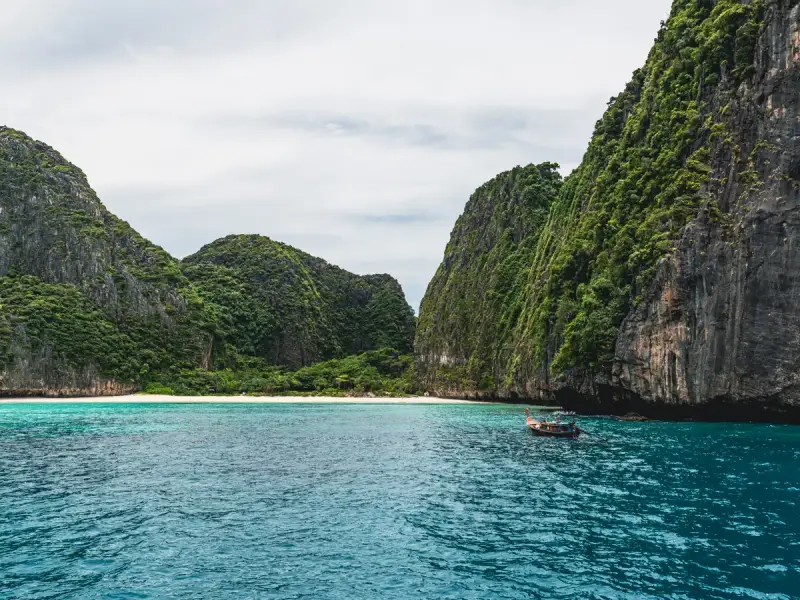
Property investment in Thailand
A guide that walks investors through every stage, from picking a unit to collecting steady rental income
Photo: Kirandeep Singh Walia, Pexels
$2,993/m²
Median in the Housebook catalogue
based on 329 of 330 projects
$47,101
Entry from
330
Projects in the catalogue
$2,993/m²
Median in the Housebook catalogue
based on 329 of 330 projects
$47,101
Entry from
330
Projects in the catalogue
The property market in Thailand right now
$2,993/m²
Median in the Housebook catalogue
based on 329 of 330 projects
330
Projects in the catalogue
Units on sale: 11,852
2026-08-30
Exchange rate as of
openexchangerates.org, cross-checked
$2,993/m²
Median in the Housebook catalogue
based on 329 of 330 projects
330
Projects in the catalogue
Units on sale: 11,852
2026-08-30
Exchange rate as of
openexchangerates.org, cross-checked
Spread of price per sqm in the catalogue
based on 329 of 330 projects
A price trend chart will appear once enough observations accumulate: daily snapshots of the catalogue aggregates have been collecting since August 2026, and we will not draw a line through a single point.
How Ownership Works in Thailand
Thai law does allow foreigners to own property, and we will help you pick the ownership structure that fits your situation best
Freehold
Complete ownership of a condo unit backed by a Chanote title deed, an option open only to condominiums.
- Ownership rights equivalent to what you would have back home
- No restrictions on passing the property to heirs
- Ownership lasts indefinitely, with no end date
- Applies to condos only, and foreign ownership per building is capped at 49%
- Buyers typically cover about 1% in purchase fees out of the overall 2% transfer fee
- In sought-after projects, availability can be tight
Leasehold
A 30-year lease that can be renewed twice more (30+30+30, up to 90 years total). Note that renewals past the first 30-year term rest on contract terms, not a guarantee under Thai law.
- Purchase price runs 5-10% lower
- Transfer fee is lower, at 1.1%
- Open to villas and land plots as well
- Renewal rests on the contract, with no legal guarantee behind it
- Some theoretical exposure if the project changes hands
- Financing can be more difficult to arrange
Thai Company
Some foreign buyers set up a Thai-registered company to hold freehold title, a route that requires at least 51% Thai shareholding.
- Makes freehold ownership of land or villas possible
- Control is maintained through the share structure
- No worries about a lease running out
- Using nominee shareholders is against the law and authorities actively pursue it
- Needs real Thai shareholders holding at least 51%
- Setup and ongoing compliance cost more
Due diligence checklist
Residency Pathways
Visa options that international property buyers frequently look into
Thailand Privilege (Elite)
A long-term visa that does not permit work, bundled with VIP airport handling, government concierge services and discounts on medical care.
LTR Visa (Long-Term Resident)
A 10-year visa aimed at wealthy individuals, retirees, remote workers and highly skilled professionals, with possible income tax advantages.
Retirement Visa (O-A)
Open to those aged 50 and older, provided they can show financial means such as THB 800K held in a Thai bank account or THB 65K in monthly income. Renewal is required annually.
Important Note
Owning property by itself does not confer residency rights in Thailand. Staying long-term calls for a separate visa arrangement.
Both eligibility rules and tax benefits can change over time, so consult a qualified immigration advisor.
Taxation
The main taxes and fees tied to buying and holding property in Thailand:
Freehold (Condominium)
Combines a 2% transfer fee, 0.5% stamp duty (or 3.3% SBT if the seller owned it under 5 years), and withholding tax. The overall total shifts case by case, and how it splits between buyer and seller can be negotiated
Leasehold (Lease)
A 1% registration fee on the total lease value plus 0.1% stamp duty, landing near 0.55% of the purchase price for the buyer
Specific Business Tax (SBT)
Owed by the seller when they have held the property less than 5 years. If this tax does not apply, a 0.5% stamp duty applies instead
Withholding Tax on Sale
Runs on a progressive scale from 1% to 35% of appraised value, based on the amount and how long the property was held. For juristic persons it is a flat 1%
Rental Income Tax
For residents (183 days or more in-country), rates progress from 0% to 35%, with a standard 30% deduction against gross income. Because of that deduction and the bracket structure, the actual rate paid on moderate rental income lands well under the 35% headline figure. Non-residents (fewer than 183 days) face a 15% withholding on gross rental income, though filing a return lets them apply the progressive rates and deductions instead. A tax specialist can advise on your specific case
Annual Land & Building Tax
For residential property: 0.02% if you occupy it yourself (the first THB 50M is exempt), or 0.02-0.1% if it is held as an investment. The exact rate hinges on appraised value and how the property is classified for use
What you owe in tax depends on the ownership structure, your tax residency, how the property is classified, and current regulations. Professional tax advice is mandatory.
How a Purchase Unfolds
Five stages that take you from picking a property to steady rental earnings
True Cost of Ownership
Know every expense involved before committing your capital
Variable costs (% of income)
Fixed annual costs
We will shortlist projects in Thailand for your budget and goals
Get a shortlistGuaranteed Returns: The Essentials
A clear-eyed look at guaranteed income programs in Thailand's property market
Under these programs, a developer commits to a fixed rental income, usually 5-10% a year, for a set stretch of 2-5 years. That income can come from a shared rental pool or be guaranteed to each unit individually, and once the term ends, whatever the market delivers is what you get.
ROI Lab
Compare rental yields across Phuket's leading investment neighborhoods
After deducting 33-53% in costs, net yield typically lands at 5-8% for top short-term rental spots
Net Yield Calculator
Check what you actually earn once every operating cost is factored in
Net Yield Calculator
Check what you actually earn once every operating cost is factored in
Variable costs (% of income)
Fixed annual costs
Figures are indicative, calibrated to the Phuket market, and do not constitute investment advice.
Neighbourhood Explorer
Identify the area that best matches your investment profile
Comparison matrix
| STR yield | LTR yield | Capital growth | Lifestyle | Liquidity | |
|---|---|---|---|---|---|
| Bang Tao / Laguna | |||||
| Kamala | |||||
| Kata / Karon | |||||
| Rawai / Nai Harn | |||||
| Patong |
Warning Signs to Watch For
Signals that call for a closer look, or for walking away entirely
Phuket Market Outlook 2026
What is ahead on pricing, infrastructure projects and the main risk factors
Forecast by property segment
Infrastructure developments
Risk factors
Currency & transfers
All transactions run in Thai Baht. Registering the property requires a Foreign Exchange Transaction (FET) certificate confirming the funds arrived from overseas, and we can help you find the best route for the transfer
Projects in this country
These are projects priced below the country median per square metre ($2,993 per sqm, sample of 329 out of 330 projects). Sorted by price per square metre. Prices converted to dollars at the rate of 2026-08-30.
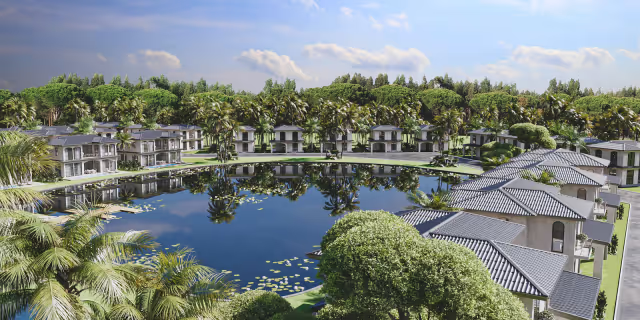
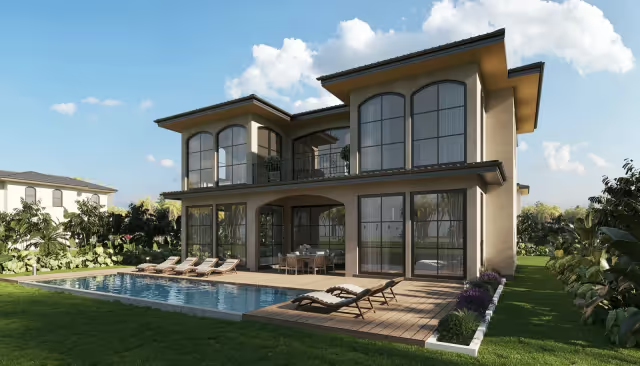


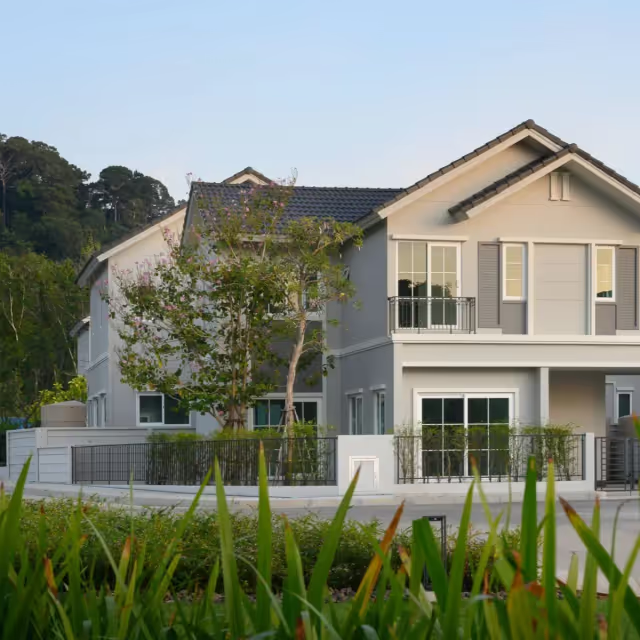

Properties selected to fit your budget and goals
Get a hand-picked list of investment properties, complete with yield figures, matched to your criteria
Handpicked Investment Opportunities
A private, hand-selected list of uncommon deals built for serious investors: land, hotels, commercial property, development, co-investment, private lending and more
Takes half a minute. We don't do spam.
- Rare deals that never hit the open market
- Real analysis, not another listings feed
- Straight-line access to deals worth a look
- One-on-one advisory whenever you need it
- Certain offers stay off the public catalog entirely
- Every listing screened by our team first
Frequently Asked Questions
Am I allowed to buy property in Thailand as a foreigner?
Yes. You can hold a condo unit on a freehold basis as long as foreign ownership in that building stays under the 49% cap. Villas and land are typically handled through a long-term leasehold, running up to 90 years. Either way, a well-structured contract and proper due diligence matter a great deal.
Can the whole purchase be done remotely?
Yes, start to finish: you can select a property over video call, reserve it with a deposit (usually $1,500-$3,000), sign the contract by email, and send payments by bank transfer. Registration is handled by a Thai lawyer under a power of attorney. Flying in is not required, though it is worth doing for due diligence purposes.
What is the process for sending funds to Thailand?
You can wire funds internationally via SWIFT from any bank, or route them through fintech providers like Wise or Revolut, which often give a better exchange rate. For freehold purchases, keep in mind a Foreign Exchange Transaction Form is mandatory. A number of developers also accept USDT.
Which taxes come into play?
For freehold, expect a 2% transfer fee plus either 0.5% stamp duty or 3.3% SBT, plus withholding tax, adding up to roughly 2-6.3% overall. For leasehold, registration lands around 0.55% of the purchase price. The annual Land and Building Tax runs 0.02-0.1% for residential use depending on how it is used. Rental income is taxed on a progressive scale up to 35%, with a standard 30% deduction available. Since the exact figure depends on your ownership structure, professional advice is recommended.
How do freehold and leasehold actually differ?
Freehold means the title sits in your own name, available for condos that fall within the 49% foreign ownership cap. Leasehold means a 30-year lease with the option to renew. Those renewals (the extra 30+30) rest on contract terms rather than a legal guarantee, though in practice they tend to be honored. Setting up a Thai company to hold freehold title is technically an option, but it carries real legal risk and authorities are scrutinizing it more closely these days. For villas, the safest fully legal path is to hold the house on freehold and the land on leasehold, and that is the approach we recommend.
How safe is an off-plan purchase?
Payments are usually staged against construction milestones, and everything you pay goes straight to the developer with no middlemen involved. What matters most is vetting the developer itself: their history, permits, financing and how the contract is structured. Having an independent Thai lawyer review it is advisable.
How is a rental property actually managed?
A professional operator takes care of marketing the unit, talking to guests, check-in, cleaning and upkeep, and you get portal access showing bookings and income. Payouts usually land in your bank account quarterly, and the operator's cut typically runs 15-30% of rental income.
What costs keep recurring after purchase?
Recurring costs include property management at 15-30% of rental income, maintenance around 5-8%, utilities 3-5%, CAM/HOA fees of $1,800-3,600 a year, insurance around $500-1,200 a year, property tax of $300-800 a year, and, for condos, a sinking fund near $600 a year. A 3-5% platform commission only kicks in for short-term rentals.
Am I able to use the property for my own stays?
Yes. Most management contracts set aside 2-8 weeks a year for your own use, the exact amount depending on the season and terms. Any time outside the rental pool is yours to use freely. If you plan to stay longer, look into a long-term visa such as Thailand Elite or a retirement visa, since tourist visas cap out at 60-90 days.
What does reselling the property down the line look like?
You can resell whenever you choose, including to other foreign buyers, though freehold sales still need to fit within the 49% quota. Phuket's market moves well and demand keeps rising, and support is available for the resale process. Capital gains are taxed on a progressive scale up to 35% of the profit.
Which documents are required?
A passport copy is enough to reserve a unit. The contract stage calls for your passport, plus a notarized copy if you are granting power of attorney. Freehold purchases need a Foreign Exchange Transaction Form proving the funds came from abroad. And for due diligence, having an independent Thai lawyer review things is recommended.
How does currency risk factor in?
Both the purchase price and rental income are set in Thai Baht, so swings in the EUR/THB rate can move your actual returns. Ways to manage this: keep a THB account for day-to-day income and expenses, spread payments out over time, set a defined window for the exchange rate, and for larger sums, look at hedging through bank or fintech products.
Is hiring a lawyer necessary?
Bringing in an independent Thai lawyer for due diligence and contract review is advisable, at a cost of roughly $900-$1,500. They check building permits, the land registry and the developer's references, and act on your behalf during the registration process.
What kind of returns are realistic?
Net rental yields in Thailand generally fall between 5% and 8% a year, before tax and after operator fees, and this varies a lot by location, occupancy and cost structure. In premium areas, capital values have grown around 3-6% a year recently. These numbers are only indicative, since actual outcomes hinge on many variables, and we are glad to run a calculation tailored to a specific property.
How do guaranteed rental programs work?
Some developers set a fixed rental income, typically 5-10% a year, for a period of 2-5 years. That guarantee is generally priced into the property itself, and once it ends, returns follow the market. It is worth comparing against similar units without a guarantee and checking where the reserve funds backing the promise actually sit.
Is a visa necessary to own property?
No, a visa is not required to buy property, though ownership on its own does not grant residency rights. For a long-term stay, options include Thailand Privilege (5-20 years, from THB 600K), the LTR Visa (10 years, aimed at wealthy individuals, retirees, remote workers and highly skilled professionals), and the O-A Retirement Visa (for those 50 and older, renewed annually). These requirements can change over time.
Other markets on the platform
A one-on-one session with an investment analyst
We will review your investment profile, work out a strategy, and estimate expected returns, at no cost and with no obligation